-
1st in Korea for 10 consecutive years in Mathematics & Computer Science … Global prestige with 36th in Asia Rose significantly to 2nd in Korea in Life and Earth Sciences compared to last year Consistently good ratings in World University Rankings ... Acceptance of world-class research capability [July 8, 2024] Overall Rankings Ranking in mathematics and computer fields Ranking in life and earth science fields Rank in Korea University name Rank in Korea University name Rank in Korea University name 1 Sejong University 1 YU 1 Sejong University 2 UNIST 2 Sejong University 2 YU 3 POSTECH 3 Yonsei University 3 Kwangwoon University 4 KAIST 4 Kyunghee University 4 KAIST 5 YU 5 Pusan National University 5 UNIST 6 Yonsei University 6 Ewha Womans University 6 Hanyang University 7 DGIST 7 Gyeongsang National University 7 DGIST 8 Korea University 8 Korea University 8 Korea University 9 Seoul National University 9 Sogang University 9 Sogang University 10 Hanyang University 10 Sungkyunkwan University 10 Dongguk University <2024 Leiden Ranking of Korean Universities> [Ranking Criteria: Top 10% Proportion of Papers (PP), Full Counting] Yeungnam University (President CHOI Oe-chool) has shown its strength by significantly rising in the comprehensive rankings of the '2024 Leiden Ranking,' entering the Top 5 in Korea. In the field of Mathematics and Computer Science, YU ranked No. 1 in Korea (131st in the world, 39th in Asia) again this year, maintaining its top position for 10 consecutive years and demonstrating its world-class research capabilities. Particularly noteworthy is YU's remarkable rise in the field of Life and Earth Sciences, achieving 365th in the world, 72nd in Asia, and 2nd in Korea (compared to last year's 839th in the world, 251st in Asia, and 9th in Korea), astonishing the academic community. Additionally, the Natural Sciences and Engineering field also improved from 17th to 11th place, further acknowledging YU's research excellence. President CHOI Oe-chool of YU stated, "The achievements of Yeungnam University in global university evaluations have been rising steadily each year, solidifying its reputation as a prestigious private university. Particularly, with our 10-year streak as No. 1 in Mathematics and Computer Science and excellent evaluations across various academic fields, we are recognized globally for our research capabilities." He added, "In this 77th anniversary year of our founding, YU's outstanding research capabilities and educational system will serve as a foundation for becoming a glocal university. We will continue to strive to nurture talent that contributes to national development and the common prosperity of human society." “Leiden Ranking” is the ranking of universities in the world based on qualitative levels of theses of universities’ research capabilities evaluated by Leiden University in Netherlands. As the ranking is calculated based on the number of papers and the ratio of paper citations excluding subjective qualitative evaluation factors such as university reputation, this is evaluated as an important indicator to measure the research performance and quality of research by universities. This year's evaluation targeted 1,506 universities from 72 countries worldwide that published more than 800 papers in international academic journals from 2019 to 2022, with 95 more universities included compared to last year. A total of 51 Korean universities were included in the rankings. The Leiden Ranking announces comprehensive rankings as well as rankings in five fields: Mathematics and Computer Science, Biomedical and Health Sciences, Life and Earth Sciences, Physical Sciences and Engineering, and Social Sciences and Humanities.
- PR team
- 2024. 07. 24
- 2024. 07. 08
- 233
-
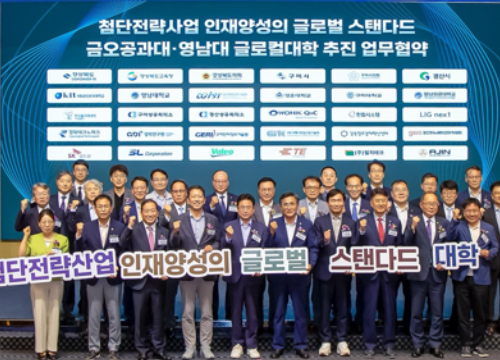
Mayor KIM Jang-ho of Gumi and Mayor CHO Hyun-il of Gyeongsan actively participate Gumi-based Kumoh National Institute of Technology, Gyeongsan-based YU support cultivation of excellent talent based on demand Cooperation plans established for 'Glocal University' and 'Advanced Strategic Industry Talent Training' [July 16, 2024] To drive the development of Korea beyond low birth rates and regional community decline, Gyeongsangbuk-do, and its industrial cities Gumi and Gyeongsan, along with representative institutions Yeungnam University (President CHOI Oe-chool) and Kumoh National Institute of Technology (President KWAK Ho-sang), have joined forces with local community institutions to declare a new leap forward for Korea. At the agreement ceremony held on July 16 at the Hotel Geumosun Convention Center, participants included YU President CHOI Oe-chool, Kumoh National Institute of Technology President KWAK Ho-sang, Gyeongsangbuk-do Governor Lee Cheol-woo, Gumi Mayor KIM Jang-ho, Gyeongsan Mayor CHO Hyun-il, and representatives from DGIST, Keimyung University, Gumi University, Yeungnam College of Science and Technology, Korea Polytechnic University Gumi Campus, local economic organizations, research institutions, and companies. They convened the 'Industry-Academic-Research Cooperation Forum and Agreement Ceremony for Leap towards a Global Standard University for Advanced Strategic Industry Talent Training'. Part 1 featured special lectures, a Glocal University briefing, and discussions among companies and research institutions. Part 2 involved signing agreements among various institutions to successfully promote the Glocal University 30 project. * Participating Institutions: ∙ (Lead Universities) YU, Kumoh National Institute of Technology ∙ (Local Governments and Educational Institutions) Gyeongsangbuk-do, Gyeongsangbuk-do Council, Gyeongsangbuk-do Office of Education, Gumi City, Gyeongsan City, Gumi City Council ∙ (Participating Universities) DGIST, Keimyung University, Gumi University, Yeungnam College of Science and Technology, Korea Polytechnic University Gumi Campus ∙ (Participating Companies) SK Siltron, SL, Valeo Mobility Korea, Tyco AMP, Iljin Tech, Ajin Industry ∙ (Economic Organizations and Research Institutions, Regional Councils) Gumi Chamber of Commerce and Industry, Gyeongsan Chamber of Commerce and Industry, Gumi Semiconductor Industry Association, Gumi Defense Industry Association (Co-chair), Gyeongbuk Technopark, Gyeongbuk Research Institute, Gumi Electronics and Information Technology Institute, Gyeongbuk IT Convergence Industry Technology Institute, Gyeongbuk Creative Economy Innovation Center, Gyeongsan Innovation Academy The 29 institutions that signed the agreement pledged to establish partnerships and strengthen cooperation for: - Overall exchange and cooperation for promoting the Glocal University - Customized talent training for regional strategic industries such as semiconductors and AI/SW - Operating lifelong education programs responding to changes in regional industry demand - Enhancing local industry development and talent exchange through close alliances among region, industry, academia, and research institutions - Providing phased, customized startup support to create an entrepreneurial ecosystem - Establishing a comprehensive management system for international students to promote global co-prosperity with the region. Before the agreement ceremony, a special lecture by JUNG Je-young, President of the Korea Education and Research Information Service, was held on 'Digital Transformation and Future Education Strategies of Universities'. JOO Baek-seok, Director of Planning and Cooperation at Kumoh National Institute of Technology, presented on the 'Glocal University Project' jointly promoted by Kumoh National Institute of Technology and YU, outlining implementation plans to lead regional advanced strategic industry development and synergistic growth of the university, region, and industry. The ensuing discussion among companies and research institutions explored ways to activate close exchanges among related organizations. Gyeongsangbuk-do Governor LEE Cheol-woo stated, "This agreement will further solidify our mutually supportive and cooperative relationship to create a Gyeongbuk-style Glocal University educational innovation ecosystem," and pledged administrative and financial support to ensure all regionally designated Glocal Universities achieve final selection. Gumi Mayor KIM Jang-ho remarked, "The designation of the YU-Kumoh National Institute of Technology joint Glocal University is not just about university development but also creating a new growth engine for the development of Gyeongbuk. Gumi City will fully commit to providing comprehensive administrative and financial support to secure the designation." Gyeongsan Mayor CHO Hyun-il expressed, "I am confident that the designation of YU and Kumoh National Institute of Technology as a Glocal University will merge the strengths of both institutions to enhance synergy, establishing them as central universities connecting the region and the world, leading to new levels of growth and development for Gumi and Gyeongsan." President KWAK Ho-sang of Kumoh National Institute of Technology stated, "Kumoh National Institute of Technology and YU have created a platform for nurturing talent in advanced strategic industries and established an implementation plan to spread the pioneering spirit that powered Korea's industrialization globally. We thank the local universities, governments, companies, and research institutes for their shared vision and support, and we hope our bold journey to create a new international standard in higher education through the Glocal University designation will accelerate." President CHOI Oe-chool of YU said, "We are pleased to establish agreements with industry-academia-research institutions to jointly lead regional co-prosperity and growth, the core goal of the Glocal University 30 project by YU and Kumoh National Institute of Technology. We hope this will be a crucial moment where universities and local communities come together to cultivate talents who will elevate Korea to an advanced nation of distinction and create a new future for the region through the development of regional advanced industries. We will strive to lead regional innovation through close cooperation with region-industry-academia-research institutions and create a successful model for the Glocal University project beyond its selection." Previously, YU and Kumoh National Institute of Technology were preliminarily designated for the Glocal University 30 project as a joint model focusing on semiconductor and software talent training, regional advanced industry development, startup support, and the creation of a global youth village. Building on this agreement, universities, local governments, regional companies, and research institutions will work together to challenge the final designation of the Glocal University 30 project by the upcoming deadline on the 26th, establishing an innovative planning model that leads regional innovation.
- PR team
- 2024. 07. 24
- 2024. 07. 16
- 274
-
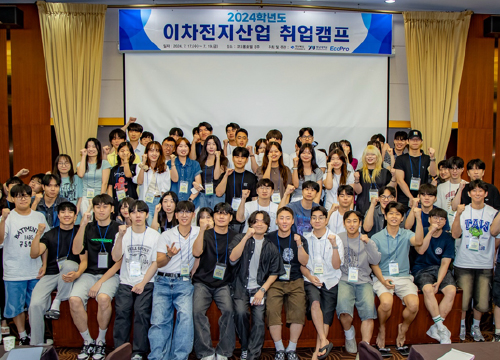
YU, Gyeongsangbuk-do, and Ecopro Affiliates Host '2024 Secondary Battery Industry Employment Camp' Industry professionals deliver hands-on, job-focused training over a three-day, two-night camp Insightful sessions on recruitment, job roles, and company life [July 19, 2024] To enhance employment capabilities in the specialized local battery industry, Yeungnam University (President CHOI Oe-chool), Ecopro affiliates, and Gyeongsangbuk-do have jointly hosted the '2024 Secondary Battery Industry Employment Camp'. This program aims to equip students with the latest trends and information in the secondary battery industry and enhance their job readiness to meet industry demands. From July 17 to 19, a two-night, three-day intensive training session was held at Namsan Hall, Kolon Hotel, in Gyeongju, with over 80 students from YU's Department of Chemical Engineering, Department of Materials Science and Engineering, and Department of Chemistry participating. The training included lectures on employment trends and strategies, and resume writing to strengthen basic job skills. Industry professionals from battery companies provided insights into corporate and industry trends, conducted job-specific mentoring, and shared comprehensive information on recruitment, job roles, and company life, garnering a positive response from the participants. KIM Do-hoon, a senior in YU's Department of Chemical Engineering, said, "This training was beneficial in understanding how my academic knowledge is applied in the field and gaining information on job-specific tasks. The company introductions and job-specific mentoring also helped in my career planning after graduation." On the second day, EcoPro Senior Manager (Head of HR) CHO Yong-han introduced EcoPro, a leading company in the battery industry, and lectured on trends in the secondary battery industry. He praised the students' enthusiasm, saying, "I commend the students for their earnest engagement with the lecture on EcoPro and the industry's trends. I hope this program provides them with valuable insights into companies and job roles in the advanced industry sectors, including the battery industry." JEON In, Director of the YU Career Plus Center and professor in the Department of Business Administration, who organized the training, commented, "This camp, in collaboration with Ecopro, a leading battery company, is an industry-academia cooperative employment support program offering detailed job training. YU will continue to actively support students in enhancing their employment skills by developing various job training programs in collaboration with major local companies to meet industry needs."
- PR team
- 2024. 07. 24
- 2024. 07. 19
- 224
-
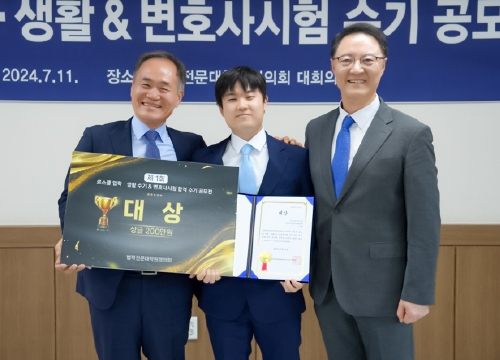
Grand Prize in the 1st Law School Admission, Life, and Bar Exam Essay Contest Hosted by the Korean Association of Law Schools Award-winning essay titled "The Tumultuous Life of a Law School Student Who Only Graduated Elementary School" [July 22, 2024] LEE Kang-il, a student at Yeungnam University (President CHOI Oe-chool) Law School, won the grand prize at the 1st Law School Admission, Life, and Bar Exam Essay Contest. The award ceremony was held on July 11 at the Korean Association of Law Schools' conference room. The contest was organized to provide prospective and current law school students with real-life insights and information. It was divided into three categories: law school admission, law school life, and bar exam success. Submissions were accepted from March to May and underwent rigorous evaluation by a panel of judges, resulting in 12 selected winners. LEE Kang-il's essay, "The Tumultuous Life of a Law School Student Who Only Graduated Elementary School," stood out among nationwide law school students. In his essay, he detailed his journey overcoming difficult economic conditions since graduating from elementary school. LEE narrated his experiences driving tractors, working in farming, slaughterhouses, operating heavy machinery, carpentry, concrete casting, wallpapering, and interior design. He shared how he persevered through these challenges, passed the high school equivalency exam, and graduated from a remote university over six years before entering law school. His honest portrayal of balancing work and study and his relentless efforts to excel in his legal studies earned high praise. LEE expressed, "I hope this essay offers some comfort and encouragement to those who may find law school daunting due to their academic background or financial circumstances. I am deeply grateful to the YU Law School professors who have always kept their office doors open and guided me with passion. I will continue to strive to become a respectable legal professional." YU Law School Dean LEE Dong-hyung congratulated LEE Kang-il, saying, "I sincerely congratulate Lee Kang-il on winning the grand prize. This will be a great inspiration for current students and those aspiring to join law school. The law school will do its utmost to support students so they can focus on their studies." Meanwhile, YU Law School produced 7 successful students in the 2024 new prosecutor selection test, ranking first in the country in the prosecutor appointment passing rate (based on the number of successful students compared to the admission quota), and ranked first in the country in the 9th Bar Examination, and ranked 2nd in the country in the 8th and 10th bar exam passing rate (based on the number of students admitted to each class), showing the prestige of a law school. In the third law school evaluations in 2023, the law school was evaluated as ‘certified’ in recognition of its excellence in operation and quality of education.
- PR team
- 2024. 07. 24
- 2024. 07. 22
- 220
-
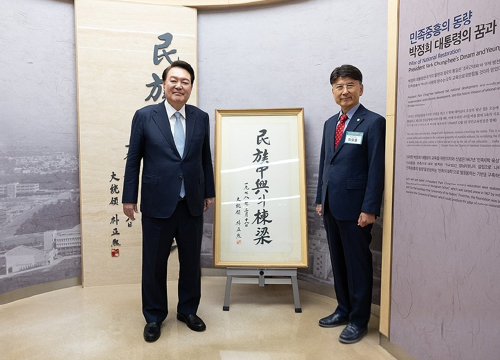
“YU is making significant efforts to promote the Saemaul Movement globally." "Many leaders at the Korea-Africa Summit spoke highly of YU's Saemaul Studies." [June 25, 2024] <President YOON Suk-yeol poses for a commemorative photo with President CHOI Oe-chool of YU in front of former President Park Chung-hee’s handwriting (photo provided by the presidential office)> During President Yoon Suk-yeol’s “People’s Livelihood Forum,” YU’s flagship program, Saemaul Studies, garnered attention. On June 20, YU's Saemaul Studies once again garnered attention, following the recent Korea-Africa Summit, during the 26th "People’s Livelihood Forum" themed "Northeast Asia Advanced Manufacturing Innovation Hub, Gyeongbuk," held at LEE Si-won Global Convention Hall of YU Cheonma Art Center. President YOON began his opening remarks by sharing his connection to YU, “When I worked in Daegu, I often visited the Samcheonji and the museum at YU. It has always been a place where I felt at ease.” He continued, “The Saemaul Movement was not just a rural movement but a comprehensive social movement that significantly empowered our people across all industries. The voluntary and leading efforts of the residents of Gyeongbuk greatly contributed to national development. YU is making considerable efforts to continue this great history and share it globally. Since the establishment of the Park Chung Hee School of Policy and Saemaul(PSPS) in 2011, the university has educated over a thousand students from 73 countries on the experiences of the Saemaul Movement.” In further remarks, President Yoon noted, “YU's Saemaul Studies, which systematizes the Saemaul Movement and our development experiences, received significant interest and attention from various leaders at the Korea-Africa Summit. I heard many stories from African leaders about how numerous national leaders and young people have studied state development at YU and made substantial contributions.” Governor LEE Cheol-woo of Gyeongsangbuk-do, who attended the forum, also highlighted the global efforts of the province's Saemaul Movement, stating, “It was President CHOI Oe-chool of YU who academicized the Saemaul Movement and established PSPS. Many influential figures worldwide have come to YU for education.” <President YOON Suk-yeol receives an explanation while visiting the history hall of YU's museum (photo provided by the presidential office)> After the forum, President YOON moved to the YU Museum, where he visited the history hall displaying records of former President PARK Chung-hee and took a commemorative photo in front of PARK’s handwritten calligraphy, reflecting on the footsteps of the leader who spearheaded Korea’s modernization. President CHOI Oe-chool of YU, who accompanied President YOON during the forum and museum visit, commented, “It seems that our efforts to academicize Korea’s development experience and the Saemaul Movement and provide Saemaul education globally have been well-received. The core spirit of the Saemaul Movement, which is solving various local development issues, remains fundamental. We will strive to contribute to regional and national development based on the Saemaul Movement and its spirit. We aim to incorporate innovative and symbiotic success models with universities, local governments, communities, and industries into the Glocal University 30 project plan, which is currently under preparation, to ensure the success of the local era.” The forum was attended by over 100 participants, including local residents, business people from the new energy industry in Gyeongbuk, startup entrepreneurs, parents, and members of the Gyeongbuk Regional Era Committee. Representatives from the government and local authorities included WOO Dong-gi, Chairman of the Regional Era Committee, LEE Sang-min, Minister of the Interior and Safety, AHN Deok-geun, Minister of Trade, Industry and Energy, PARK Sang-woo, Minister of Land, Infrastructure and Transport, and OH Young-joo, Minister of SMEs and Startups. From the presidential office, attendees included Policy Chief SUNG Tae-yoon, Economic Secretary PARK Chun-seob, and Social Secretary JANG Sang-yoon, who shared various opinions on regional development and innovation.
- PR team
- 2024. 07. 10
- 2024. 06. 25
- 867
-
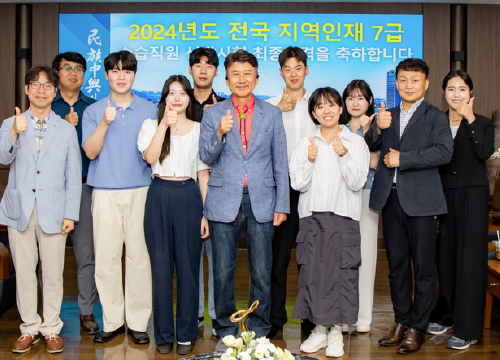
Proved highest level of competitiveness with 38 successful applicants in recent 5 years 3 for administrative and 3 for technical positions... Highest number of passers among universities in Gyeongbuk Result of systematic support in whole selection courses including written tests and interviews by College Job Plus Center [June 19, 2024] <Students and graduates from YU who were finally selected as probationary employees in 2024 National Job Level 7 Test for Local Talents> YU (President CHOI Oe-chool) produced 6 successful applicants in 2024 National Job Level 7 Test for Local Talents. This is the highest number among universities in the Gyeongbuk region. Recently, Ministry of Personnel Management announced a list of 172 successful applicants (108 administrative and 64 technical jobs) in 2024 National Job Level 7 Test. Among them, a total of six with three in administrative positions and three in technical positions were from YU. The successful candidates are PARK Min-ki (24, Department of Public Administration, 4th grade), SHIN Won-joo (24, Faculty of European Languages and Cultures, 4th grade), OH Soo-hyun (23, Department of Public Administration, 4th grade) in the administrative position, and KIM Min-ji (24, Faculty of Chemical Engineering, Graduate), SONG Sung-wan (25, Faculty of Architecture, Graduate), and CHOI Hyun-jun (27, Department of Fiber System Engineering, Graduate) in the technical position. Over the past five years, YU has produced 38 successful candidates for the regional talent recruitment program for Grade 7, showcasing top-tier competitiveness nationwide. In 2022 and 2023, YU led the nation with nine successful candidates each year.This success results from systematic and proactive support provided by the university's dedicated department, the University Job Plus Center. YU supports students throughout the entire selection process, from university recommendation to written and interview exams. YU recruits students for National Job Level 7 Test for Local Talents, prepares lectures for written tests and interviews, and allocates exclusive professor tutors, every year. Also, YU supports mock exams and studies for written tests through the University Job Plus Center and provides meetings with previous successful applicants for students to prepare for interviews. The university's comprehensive support has led to top-tier results in both quantity and quality. Most applicants pass the written exam each year, and the interview success rate stands at 100%. Last year and this year, all 18 students who attended interviews were named on the final list of successful candidates. JEON In, Director of the University Job Plus Center (Professor of Business Administration), stated, "The university provides systematic support from the recruitment stage to the final pass, achieving excellent results every year. The students interested in public officials may be highly supported by the programs operated by YU. University Job Plus Center also operates various tailored programs for employment and career guidance for general enterprises and public agencies, etc. We will make actively support students to find suitable careers to meet their aptitude and to be employed by intended agencies.” President CHOI Oe-chool of YU, who held a meeting with the successful candidates on the 14th, remarked, "Congratulations on overcoming the challenging preparation process and achieving this honor. It is essential to maintain your initial determination to become exemplary public servants and to strive continuously. I hope you will grow into public officials with the right mindset and attitude to contribute to community and national development and to serve the nation and its people." National Job Level 7 Test for Local Talents was provided in 2005 in order to strengthen local representativeness of official jobs by employing local talents uniformly. Qualified students and graduates recommended by colleges are selected through written tests (PAST and the Constitution), career paper review, and interviews under management by the Ministry of Personnel Management. Successful applicants in this year will complete basic education for adaption to public officials and enhancement of job capability in the first half of next year and will work as trainees in each central administrative agency. The training period is about one year and, after completion of the period, they will be employed as regular level 7 public officials.
- PR team
- 2024. 07. 10
- 2024. 06. 19
- 823
-
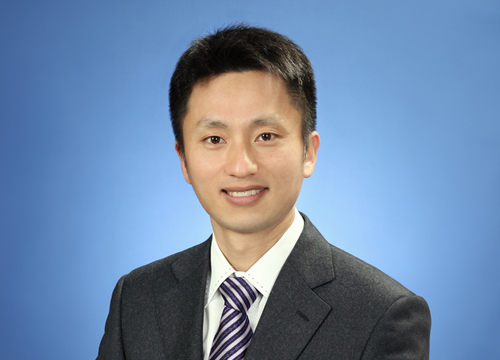
STEAM Research Project ‘Future Pioneers of Promising Convergence Technologies’ Initiative by the Ministry of Science and ICT Collaborative Research with the Department of Pharmacy for Phase 1 Plans to Develop Next-Generation Amino Acid-Based Lipid Nanoparticle Cancer Immunotherapy Vaccines [June 21, 2024] <Professor JANG Jae-hoon of YU’s Department of Pharmacy> YU (President CHOI Oe-chool) has been selected for the Ministry of Science and ICT's STEAM (Science, Technology, Engineering, Arts, Mathematics) research project under the ‘Future Pioneers of Promising Convergence Technologies’ initiative. The Future Pioneers of Promising Convergence Technologies project supports the development of mission-driven core technologies that can create and lead new technology and industry paradigms. The challenge-type project selected this time is particularly aimed at supporting convergence research to solve unexplored scientific challenges. Professor JANG Jae-hoon’s ‘T Cell Neo-Signal Transduction Research Team’ will lead a project to identify new amino acid-mediated signal transduction pathways in T cells and develop amino acid-based cancer immunotherapy vaccines.The research will be conducted in three phases over 5 years and 9 months, with potential funding of up to 4.7 billion KRW based on stage evaluations.Phase 1 will involve collaborative research with the Department of Pharmacy at YU. Professor JANG stated, “We aim to propose a new immunological dogma and develop next-generation amino acid-based lipid nanoparticle cancer immunotherapy vaccines to secure fundamental technology. This project selection marks an important starting point, and we hope to contribute to the advancement of the bio-pharmaceutical industry through our research outcomes.” Professor JANG has recently published research results in prestigious journals such as Nature Communications (IF: 16.6), Molecular Cancer (IF: 37.3), and Experimental & Molecular Medicine (IF: 12.8), earning recognition for his research excellence.
- PR team
- 2024. 07. 10
- 2024. 06. 21
- 790
-
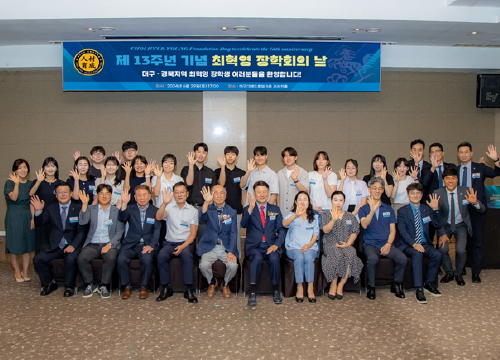
Chairman CHOI Hyuk-young, Scholarship Recipients, Parents, and University Officials Gather on June 29 CHOI Hyuk-young Scholarship Foundation Established for 'Practicing Sharing' — Offers Financial Support and Mentorship Significant Contributions to Landmarks such as 'Big Time' and 'Cheonma Tunnel Fountain' at Alma Mater [July 4, 2024] YU (President CHOI Oe-chool) hosted the ‘Daegu-Gyeongbuk CHOI Hyuk-young Scholarship Day’ event. The event, held on June 29 at the Plaza Hall of Daegu Grand Hotel, was attended by Chairman CHOI Hyuk-young of the CHOI Hyuk-young Scholarship Foundation, President CHOI Oe-chool of YU, President HEO Chang-deok of the Faculty of International Education, Director YOON Jeong-hyeon of External Relations, scholarship recipients, parents, and about 40 university officials. The Daegu-Gyeongbuk CHOI Hyuk-yeong Scholarship Foundation, established by CHOI Hyuk-yeong, Chairman of Samwoo Development and an alumnus of YU’s Department of Civil Engineering (class of '63), began selecting its first batch of scholars at YU in 2012. The foundation has since extended its reach to students at Daegu Catholic University in 2022 and Kyungpook National University in 2023, growing into a scholarship foundation that encompasses the Daegu-Gyeongbuk region. JUNG Kwang-min, a scholarship recipient and graduate student in Mechanical Engineering at YU, expressed, “The financial support from the scholarship, as well as Chairman CHOI’s encouragement and support, have been incredibly helpful during my university life. Experiencing Chairman CHOI’s love for his juniors firsthand, I hope to follow in his footsteps and support my alma mater and juniors after graduation.” <Scholarship recipient presenting a plaque of appreciation to Chairman CHOI Hyuk-young> Chairman CHOI Hyuk-young remarked, “I am grateful to YU for organizing such a meaningful event. It is immensely rewarding to watch scholarship recipients study hard, grow, and graduate. I hope each of you continues to strive towards your goals and, when you enter society, practice the value of sharing that you have experienced today.” President CHOI Oe-chool of YU, who attended the event to celebrate, said, “On behalf of the university, I would like to thank Chairman CHOI Hyuk-young, who leads the scholarship foundation for the benefit of students at his alma mater and the universities in the Daegu-Gyeongbuk region. Just as Chairman CHOI is dedicated to fostering talent and contributing to the community, we will strive to nurture individuals who can contribute to the global prosperity beyond our region.” Chairman CHOI Hyuk-young's love for his alma mater has been longstanding. Since donating 100 million KRW in 2007, he has contributed over 1.02 billion KRW to the university. Through the scholarship foundation established in 2013, he has supported students, believing that discovering individuals with good character is crucial for national development. The CHOI Hyuk-young Scholarship Foundation has selected and supported over 400 students from more than 30 universities and high schools, including YU. Chairman CHOI’s scholarship model extends beyond financial support; he also serves as a life mentor to the scholars, sharing life wisdom through letters and regular meetings. As an alumnus, Chairman CHOI has shown special affection for his alma mater and juniors. In addition to scholarship funds, he donated the full cost of installing the large clock ‘Big Time’ on the exterior wall of YU Central Library in 2018, supported the installation of the 'Cheonma Tunnel Fountain' at the university’s main gate in 2020, and funded the environmental improvement project around the 'Cheonma Tunnel Fountain' in 2024, significantly contributing to the creation of campus landmarks.
- PR team
- 2024. 07. 10
- 2024. 07. 04
- 777
-
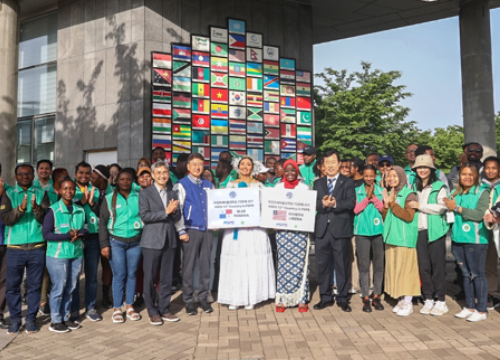
In bilateral talks on the 3rd, Presidents Yoon and Kagame discuss 'YU Saemaul Studies' Close exchanges and cooperation with African countries like Rwanda, Guinea, and Ethiopia 'Saemaul Studies' is the origin of the Korean Wave and a 'shared policy for mutual growth' [June 10, 2024] <Students of YU Park Chung Hee School of Policy and Saemaul (PSPS)> At the bilateral meetings with African leaders on the 3rd, ahead of the Korea-Africa Summit held on June 4-5, 'Saemaul Studies' at YU became a hot topic. In the meeting between President YOON Suk-yeol and Rwandan President Paul Kagame, it was mentioned that Rwandan students are studying 'Saemaul Studies' at YU's PSPS. This can be seen as an example of the long-standing exchanges, cooperation, and achievements between YU and African countries through Saemaul Studies. The exchange between YU and Rwanda dates back to November 2020 when Yasmin Amri Sued, then Rwandan Ambassador to South Korea, visited Yeungnam University to discuss Rwanda's national development plan. Following this, an international exchange agreement was signed with the Rwandan Ministry of Education at the request of the Rwandan government, within four months. Rwanda has actively sought to adopt the 'Saemaul Studies' curriculum developed by YU and to learn the know-how of implementing the Saemaul Movement locally and the development experience of Korea through the movement. In the agreement, it was decided to: ▲Conduct pre-verification and recommendation of the Rwandan Ministry of Education for applicants to the YU PSPS ▲Recommend universities by the Rwandan Ministry of Education for the establishment of a local department of Saemaul ▲Designate the Global Saemaul Development Network (GSDN) as an executive organization for the establishment of the local department of Saemaul and register as a local NGO. <YU hosted the Global Saemaul Forum on May 28-29> At the Global Saemaul Forum, held to commemorate the 77th anniversary of YU on May 28-29, aimed at sharing educational paradigms for sustainable global development and presenting the university's vision for nurturing talents contributing to humanity, Nkubito Manzi Bakuramutsa, the Rwandan Ambassador to South Korea, praised the Saemaul Movement. He stated, "Rwanda has adopted the Saemaul Movement as a development policy for sustainable national development. Through the Saemaul Movement, Rwanda has seen positive changes, particularly aiding the post-war reconstruction efforts." Ethiopian Ambassador to South Korea, Dessie Dalkie Dukamo, who has had close relations with YU even before Rwanda, also praised the movement, saying, "YU, as the hub of the Saemaul Movement, has made it an international policy through global cooperation and led the eradication of poverty worldwide. The Saemaul Movement I learned at YU 9 years ago during my tenure as governor greatly helped me as a regional leader. The Saemaul Movement is a model and lesson that developing countries should learn." Additionally, the government of Guinea, following the agreement on sharing the Saemaul Movement with the Ministry of Higher Education, Science, and Innovation of Guinea last year, visited YU again this May. Felix Lamah, Minister of Agriculture and Livestock of Guinea, and LIM Hyoung-jun, Head of the WFP Office in Guinea, requested sharing the Saemaul Movement and Korea's development experience and agreed to cooperate in establishing the Saemaul Community Development Department and Research Center within Guinean universities. YU has spent the last several years leading the efforts to share Saemaul studies with the international community. Starting with the establishment of the Department of Saemaul Economic Development at Enderun College in the Philippines in 2015, the Department of Saemaul Economic Development at Western University in Cambodia, and the Department of Saemaul Studies at Samarkand State University in Uzbekistan, and from September this year, the Department of Sustainable Saemaul Forestry at Werabe University in Ethiopia, YU has received requests from over 10 countries to support the establishment of Saemaul Studies departments and Saemaul Movement research centers at their major universities. <Students of PSPS sing the Saemaul Song at the opening ceremony> YU founded PSPS in 2011 and has provided Saemaul education to 904 social leaders from 73 countries, producing 766 master's graduates so far. Graduates are currently working as major policy-makers, international development experts, and Saemaul Movement leaders at central governments, public institutes, and international development NGOs. The nationality composition of the students includes 29 African countries, 23 Asian countries, and 21 other regions, showing global interest in Saemaul Studies, especially with two students from Cuba, even before diplomatic relations were established, enrolling in the International Development Department of Saemaul in 2018. The Yeungnam University Institute for International Development Cooperation (IIDC) also provides short-term training on Saemaul Movement and Saemaul Studies theory and practice to policy experts and private sector professionals from developing countries. The IIDC aims to strengthen policy capabilities related to rural development and community development in the training target countries, improving community development, farm income, and quality of life. The IIDC's short-term training has educated over 3,300 people from 48 countries so far. YU has also awarded honorary doctorates in international development to individuals who have significantly contributed to global issues, such as former World Bank President KIM Yong and former UN World Food Program Secretary-General David M. Beasley, enhancing its status as a global hub for Saemaul Movement education. <YU President CHOI Oe-chool delivers a welcome speech at the 77th-anniversary Global Saemaul Forum> YU President CHOI Oe-chool, who has spearheaded the academicization of Saemaul Movement and its educational dissemination, said, "Korea is the only country to leap from the poorest country to a developed country, and the Saemaul Movement played an important role in this process. This is why many international organizations and countries request the transfer of Saemaul Studies to YU." He added, "We will strive to make the Saemaul Movement a leading K-policy brand expanding the scope of the Korean Wave through the Smart Saemaul initiative reflecting the characteristics of the era. We will also do our best to nurture talents who contribute to the sustainable global prosperity. The experience of Saemaul development and Saemaul Studies has become an important product of Korea's diplomacy and a crucial strategy for mutual growth with developing countries."
- PR team
- 2024. 06. 28
- 2024. 06. 10
- 1761
-
Among 800 papers presented at the 2023 Korean Society of Energy Autumn Conference, recognized for the best paper Acknowledged for 'Optimal Design Technology for Vertical Agrivoltaic Systems' Highlighted as new technology for rural development and preventing regional decline [June 11, 2024] <Professor JEONG Jae-hak from YU School of Chemical Engineering receives the Best Paper Award at the Korean Society of Energy Autumn Conference.> Professor JEONG Jae-hak (62) from YU School of Chemical Engineering has been awarded the Best Paper Award at the 2023 Autumn Conference of the Korean Society of Energy. Professor JEONG's paper was selected as the best among over 800 papers presented on the theme of "Latest Technological Trends in the Development and Utilization of New Energy Sources to Curb Carbon Emissions in Response to Climate Change" at the Korean Society of Energy's Autumn Conference held last October. The results of this rigorous evaluation were announced in May 2024, earning him this prestigious award. The awarded paper focuses on developing and demonstrating cutting-edge design technology that enables simultaneous farming and electricity generation on agricultural land. Specifically, it presents a design technology that sets up solar cell modules vertically, thereby not adversely affecting crop cultivation while producing economically viable electricity. This is the first empirical research result on vertical agrivoltaic systems in Korea, recognized as a new technology that can boost the rural economy, increase farm incomes, and prevent regional decline. Last year, Professor JEONG was honored with the Yeungnam University Excellent Research Award. Notably, he has a pioneering history of integrating solar power generation with crop cultivation on farms, being the first in domestic universities to initiate research on agrivoltaic systems. Additionally, he served as the head of the Daegu-Gyeongbuk branch of the Korean Society of Chemical Engineers in 2023.
- PR team
- 2024. 06. 28
- 2024. 06. 11
- 1755